Saturday, May 2, 2009

Anixiatiki (Spring) Salad

img_4478Yesterday was May 1st and in Greek tradition, a Greek will greet their fellow Greeks with a “Kalo Mina” or “Good Month”. May 1st is also the European equivalent of the North American Labour Day.


In Greece and much of Europe, a celebration and remembrance of the social and economic achievements are marked with parades and other events.


Greece (again) is in the midst of a long weekend, the warm sun reminding everyone that those long hot days are near, flowers in full bloom and the Spring produce in abundance at the markets and family plots.


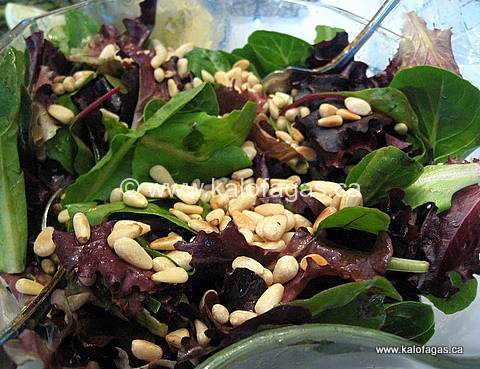
This past Easter, another pleasant surprise at our family’s table was this “Anixiatiki (Spring) Salad. The recipe was discovered whist flipping through the last issue of Gastronomos.img_4481-11
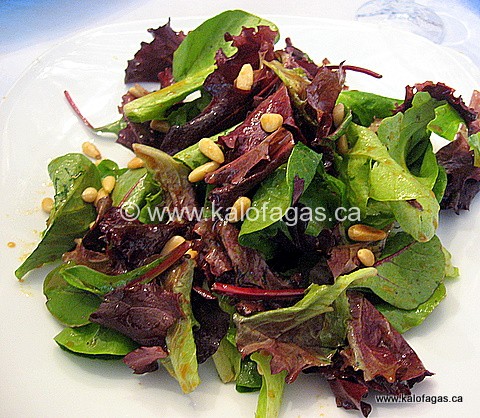

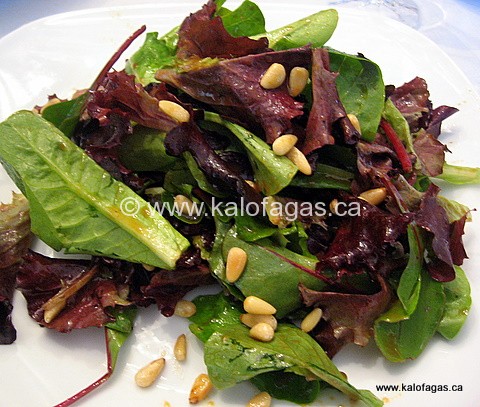
What sets this salad apart is that the dressing is warm, an array of Spring (and seasonal) greens are used and toasted pine nuts round out this simple, delicious salad.


I am going to make this salad again this evening and I thought to share it with you all. Choose your favourite salad green, toast some pine nuts and toss everything into this delightfully warm dressing.


Anixiatiki (Spring) Saladimg_4482

(for six)


Approx 450gr. of Spring or Mesclun salad mix


2 scallions, chopped


3 Tbsp. of chopped fennel or dill fronds


1/2 cup of pine nuts


Warm Vinaigrette


1/3 cup extra-virgin olive oil


3 Tbsp. warm water


3 Tbsp. Balsamic vinegar


1 Tbp. good honey (Greek if possible)


1 tsp. Dijon mustard


sea salt  and cracked black pepper to taste


  1. Thoroughly wash your salad greens and remove excess water. I use a salad spinner. Add your chopped scallions and and reserve.

  2. In a small skillet over medium heat, toast your pine nuts while constantly shaking the skillet. As soon as you can catch the aroma of the pine nuts, take off the heat and reserve in a small bowl.

  3. To make the vinaigrette, place your Balsamic vinegar in a small pot along with the mustard, honey and water. Heat over medium-low heat and simmer for a couple of minutes. Take off the heat and whisk in the olive oil and add salt and pepper to taste. Reserve and keep warm until the salad is served.

  4. Pour the warm vinaigrette over your salad along with the pine nuts, chopped dill (or fennel fronds) and gently toss. Serve while the dressing is still warm.


If you are not reading this post in a feed reader or at  http://kalofagas.ca then the site you are reading is illegally publishing copyrighted material. Contact me at truenorth67 AT gmail DOT COM. All recipes, text and photographs in this post are the original creations & property of the author.


© 2007-2009 Peter Minakis


Share/Save/Bookmark


Does home cooked mean healthy?

Guest contributor: Karen Collins, M.S., R.D., C.D.N.

Karen Collins holds a B.S. degree from Purdue and an M.S. degree from Cornell, both in nutrition. When she’s not writing or speaking, she conducts a private nutrition practice in Jamestown, New York.

By now you've probably heard the reports highlighting the increased portions, high calories and nutritional disadvantages of restaurant meals. Now that the economy is reportedly prompting us to cook more, we might assume that we are eating healthier.


Maybe not. Home-cooked foods have also seen the same unhealthy trends as restaurant foods, according to a new Cornell University study. In the study, the average calories per serving jumped 63 percent among the recipes followed over the past 70 years.


Home cooking often still holds a nutritional and weight control advantage over eating out; this study simply reminds us of the need for a quick mental check before we assume that our home-cooked meal is truly healthy.


Servings bigger, fattier these days


The Cornell study examined 18 recipes published in all editions of the classic cookbook, The Joy of Cooking, starting from the first 1936 edition through the latest in 2006. Calories increased as recipes called for larger amounts of butter, sugar and sour cream. Dishes that originated with little meat added larger amounts.


Portion sizes also expanded through the years. Most notable was the 33 percent increase in portion size that occurred from the 1990s cookbook to the current edition. The same amount of chicken gumbo that was once considered 14 servings is now 10. Using the same size pan, a recipe that made 48 brownies in 1946 shrunk to 30 in the 1960s and now makes only 15 brownies.


Vegetable variety is an improvement


However, not all the changes are bad. In the 1946 edition of The Joy of Cooking that I inherited from my mother, the section on vegetables includes only two to four ways of fixing many of them. Most often, one of those is boiling the vegetable and another is sautéing or frying.


Each generally relies on butter, cream sauce, cheese sauce or Hollandaise sauce for added flavor, rather than the herbs, spices and flavored vinegars favored today. Some vegetables, such as bok choy, aren't even included. There's no encouragement to exceed a basic half-cup portion, whereas today's health message encourages us to make vegetables a major portion of our plates.


Cut portions, trim sugar and fat


To ensure healthy home-cooked meals. Brian Wansink, lead author of the Cornell study, suggests assuming that today's recipes make twice as many servings as stated to achieve healthy portions. When it comes to baked goods, if a recipe says it has 400 calories per serving, whatever the serving size, it's too big.


Another option is to look at amounts of basic ingredients in a recipe and adjust as needed. For desserts, you can also look at the amount of fat and sugar and divide by the number of servings. If there's a tablespoon or more of sugar or fats (butter, margarine or oil) per serving, try cutting back on the amount by about a quarter.


Try more vegetables than meat


For a mixed dish like stew, gumbo, goulash or chili, put in two and a half to four ounces of uncooked boneless meat, fish or poultry for each person you're serving to provide an adequate two- to three-ounce serving after it's cooked. Double up on the vegetables or add one or two additional types to include at least a half-cup of non-starchy vegetables per person (potatoes count as a starchy vegetable); a cup or cup and a half is even better.


Studies show that when we eat out, calorie consumption increases and nutritional quality decreases. But if we cook at home most of the time, what we eat there matters. Don't assume it's healthy; limit portions and watch ingredients to make sure it is.


(This article was provided by the American Institute for Cancer Research in Washington, D.C. A registered dietician is available to respond to questions about diet, nutrition, and cancer at the free AICR Hotline at 1 (800) 843-8114 during business hours.)


From the RSS feed of CalorieLab News (REF3076322B7)


Does home cooked mean healthy?


Dr. J will see you now: Me and my Arrow

Contributor: “Dr. J”

Dr. J offers his irreverent, slightly irrelevant, but possibly useful opinions on health and fitness. A Florida surgeon and fitness freak with a black belt in karate, he runs 50 miles a week and flies a Cherokee Arrow 200.

dr-j-arrow


I've been flying the Arrow for many years! I remember the first time I saw it, parked between two less impressive planes on the ramp. I had flown to another airport with two of my former flight instructors to make the buy/no-buy deal. Seeing the plane was a mixture of excitement and trepidation, as making the step from new pilot to actually owning my own aircraft lay before me.


I knew I would be buying some plane. Once my mind crossed that gap, it was only a matter of time. I had scoured the for sale pages in the trade magazines and found this very potential candidate.


We met the plane broker, talked for a while, and then the four of us climbed in, me in the left seat, reserved only for the pilot. After going through the checklist, we cranked it up and off we went. It was fast, much faster than the smaller, less-powerful trainer planes I was used to. The added speed was a little frightening! Very soon that first flight was over and I had a lighter wallet, but my own airplane!


I still very much enjoy flying the Arrow, as you can see. This video was made during a recent flight from Florida to northern Virginia. Initially it shows the east coast near Savannah, then west of Charleston, through North Carolina and Virginia. The first large city is Richmond, and the return trip was over Raleigh-Durham then on southwest along the coast to Florida.


The Arrow has changed a little over the years. I've done speed and engine modifications, new avionics and a custom paint job that, as an artist, I designed. It's my one-of-a-kind bird! I also named the plane: "Arrow."


Now that may seem a little coincidental and redundant, but the plane is actually named after a dog, not the American Indian "Cherokee Arrow" that its designer christened the model. Years ago, Harry Nilsson wrote a song "Me and My Arrow," about a very unusual boy and the dog that changed his life. The story was also made into an animated film, "The Point."


So what's "The Point?"


Seems like a simple question. Have you ever noticed that questions may be simple; answers, not so much? Some points are quite pointed, others mostly pointless. What may seem to point in one direction often points in another.


Can we make a point without a point? A round ball has no points, but can be used to score points. I've heard it's impolite to point, but pointing out a solution can be very useful. Do we need a point to have a point, or does being pointless mean we have reached the point of no return? It's all so very pointed!


In "The Point," Harry Nilsson tells the story of Oblio and his dog, Arrow, who are banned from the village where they live mostly because Oblio looks different! You see in his town everyone and everything has a point, and Oblio was born with a round head! He is called pointless, however, Oblio in the end finds that nothing is pointless, least of all himself.


The fable stresses the merits of raising a child according to his or her own unique nature. Our main character, Oblio, is an outcast, a victim of social conventions, prejudices and jealousies. His adventures after leaving the town with Arrow allow him to discover things about himself and the larger world around him. The film illuminates fitting into society without losing one's identity.


It's a charming tale, with Nilsson's music throughout. Much of the story can be seen on YouTube.


I trust you will enjoy it. If you have young children, watch it together as a family.


Does my Arrow have a point? Well, yes it does, the spinner on the front is pointed, but that doesn't really matter, because Me and My Arrow make our points as we travel those incredible, ever changing, highways in the sky, going from point to point!


(Send your questions for Dr. J to calorielab@gmail.com or leave a comment. If your question is used by Dr. J, CalorieLab will send you a $25 Dining Dough restaurant certificate — limited to U.S. residents. More Dr. J posts can be read in our archives.)


From the RSS feed of CalorieLab News (REF3076322B7)


Dr. J will see you now: Me and my Arrow


Pregnancy news: Tons of dangers, some benefits and ways to make it easier


Lots of things affect baby in womb


Women who are pregnant or thinking about becoming pregnant usually know a whole list of things it's a good idea to avoid while pregnant, including alcohol, tobacco, recreational drugs and certain foods. But new studies show some more things moms-to-be need to worry about, some obvious, some less so.


It makes sense that being on meth while pregnant isn't a great idea (your kid is likely to have brain abnormalities that will cause developmental delays), but less obvious is the news that an epilepsy drug, valproate, prescribed for everything from migraines to psychiatric disorders, may lower a child's IQ when taken while pregnant.


Being exposed to Hong Kong flu prenatally can also interfere with brain development and reduce intelligence, while a low amount of vitamin D during pregnancy can increase the risk of a need for Caesarian delivery.


Canadian research suggests that getting too much folic acid, a nutrient we've long been told was essential to proper fetal development, may actually increase cancer risk in offspring (the research thus far has been done on rats).


And beyond supplements and drugs there are other dangers lurking for babies (and potential babies, for that matter). For instance, men who eat lots of meat and dairy have been found to have lower sperm quality than men who eat more fruit and vegetables, according to a Spanish study.


And short women in India were found to have children that were 70 percent more likely to die before age 5 than children born to taller mothers, which could be because short women (classified here as less than 57 inches tall, or 4 foot 9) may not be as healthy as taller women.


More trouble with obesity


We already know that being obese isn't great for anyone's health, and obese moms potentially have more complications than thinner moms when pregnant. Research from Texas shows that it can be more difficult for ultrasound technicians to see fetal abnormalities on the ultrasounds of overweight and obese women, as well as in those with diabetes.


An incorrect reading for a baby with a serious birth defect happened about once in every 250 births for normal weight women and one in 100 times for heavier women, making the screening about 20 percent less effective in heavier women.


And when it comes to prenatal obesity, many women don't see themselves as obese who really are, according to an Irish study. Scientists said 22 percent of women were incorrectly classified when self reporting was used to determine body mass index, with the average pregnant woman underestimating her BMI by about 5 percent.


Activities good for mother and child


While in the past women were encouraged to take it easy and eat for two while pregnant, you never hear either of those pieces of advice any more, and most women are told to get some exercise while they're gestating, but many don't follow it.


A study that's soon to be released shows that the most common reason moms-to-be say they don't exercise is lack of time, but 85 percent of those surveyed watched at least an hour of television or spent at least an hour on the computer and 77 percent spent the same amount of time writing, reading or studying.


Both body mass index and pre-pregnancy weight were lower in the women who exercised, and exercise levels were found to be higher in women who worked outside the home.


Getting a little movement in during labor also seems like a great idea, as a report from The Cochrane Collaboration found. The process of early labor seems to go more slowly when it's done lying down, but sitting, standing or walking around may make the process go more quickly and is perfectly safe. Women who moved a bit spent about an hour less in early labor on average than those who stayed in bed.


Finally, one thing you can do that has great benefits for both mother and child is breastfeeding. There's evidence that breastfeeding can help prevent obesity in children as well as asthma and some infections, and new research says that moms who breastfeed are 10 percent less likely to have heart disease or a heart attack or stroke than women who never breastfed.


Even breastfeeding for just a month could lower the risk of diabetes, high blood pressure and high cholesterol in mothers, the report in the journal Obstetrics and Gynecology says.


(By Sarah E. White for CalorieLab Calorie Counter News)


From the RSS feed of CalorieLab News (REF3076322B7)


Pregnancy news: Tons of dangers, some benefits and ways to make it easier


Dr. J will see you now: On crosswinds in health and fitness

Contributor: "Dr. J"

Dr. J offers his irreverent, slightly irrelevant, but possibly useful opinions on health and fitness. A Florida surgeon and fitness freak with a black belt in karate, he runs 50 miles a week and flies a Cherokee Arrow 200.

Crosswind is a term that can strike fear in the hearts of even the most seasoned pilots! Chuck Yeager, considered by many to be one of if not the best pilot ever, has not escaped the danger of crosswinds.


Ideally, take-offs and landings are performed directly into the wind. Unfortunately, unless you are flying a helicopter or landing on an aircraft carrier, with the immobility of runway direction crosswinds are going to happen.


Taking off with a crosswind is the lesser of the two evils. The plane tends to weathervane into the direction of the wind, and using the controls, it's just a matter of maintaining runway direction as the climb out continues. Landing, on the other hand, can be much more challenging, if for no other reason than with takeoff the plane is headed into the soft sky while with landing we are headed toward the firm earth!


Landing with a crosswind


There are basically two techniques that pilots use to land in a crosswind, the crab and the sideslip. Most of us use a combination of the two as we transition from flying the machine to taxiing it along the runway.


The less the wind is from the front, and the more it is from the side, the more difficult it is to maintain runway direction. Also, if there are gusts where the wind speed and direction is constantly changing, the landing difficulty increases.


Professional pilots test airplanes before they are ever let out for us to use. "Plays well with others" is a standard requirement for the modern aircraft, within certain limits. For the Arrow, 20 miles an hour is the maximum recommended crosswind component for landing, meaning that the pro could not keep the plane on a straight course with any greater wind speed coming directly from the side.


Crosswinds in health and fitness


I'm sure all of us have or will have to face problems that are at odds with the direction we want to go. How we handle these crosswinds can make all the difference in whether they are a mere wind bump or a hurricane in their effect on our health and fitness efforts.


Because I like to run outside, I have had to deal with poor weather, especially when I was in school in the northeast. The cold never stopped me because I found Gore-tex running suits and dressed in layers. When the mechanical obstacles like ice and snow were too severe, I changed to using a treadmill to get it done.


Injuries have come and gone. I've been fortunate enough to know when I could ice and bandage it, or when I needed to find cross-training ideas to keep on keeping on. Of course there have been wardrobe malfunctions on my fitness voyage, but enough about that.


I think if I've learned any lesson, it's been that if I wanted to, I could find ways to maintain my fitness.


I'm sure each and every one of you have felt the push and power of your own unique crosswinds. Hopefully, as I have, you have taken them one at a time and found your way to safely land and move on to fly another day.


One of the nice things about the health and fitness community online are the many resources that are available for help. This site, and several of the regular commenter's sites are always open to questions and offer solutions based on our individual experiences. It's a wonderful example of the whole being greater than the sum of the parts!


Flying the winds


I went flying the other day and the winds were quite strong. You can see from the takeoff video that the orange wind sock is straight out, meaning a 20 mile an hour wind at the least. You may also have noticed that it is in the direction of the runway, however, while I was in the air the direction changed.


Later in the day when I returned to base, the winds were 20 miles an hour sustained and coming directly from the side of the runway heading, with variable direction gusts to 25 miles an hour.


We have a saying in aviation, "Better to be on the ground wishing you were in the air, than in the air wishing you were on the ground!" Takeoffs are optional, landings are not. I was, however, confident J.


You can see on the video of the landing, how the plane was buffeted and rocked by the winds. None of these movements are staged, the video camera is fixed to the left side of the windshield. I just turned it on and flew the plane.


So what kind of crosswinds have you faced, and how did you make your landing sweet?


(Send your questions for Dr. J to calorielab@gmail.com or leave a comment. If your question is used by Dr. J, CalorieLab will send you a $25 Dining Dough restaurant certificate — limited to U.S. residents. More Dr. J posts can be read in our archives.)


From the RSS feed of CalorieLab News (REF3076322B7)


Dr. J will see you now: On crosswinds in health and fitness


More swine flu cases worry health officials


We told you earlier this week about two cases of an unusual form of swine flu diagnosed in children from California. Now it looks like those two were just the beginning of a larger problem that may already be in two states and throughout Mexico.


Though it's not possible to get swine flu from eating pork products, and this variation doesn't seem to have started with contact with pigs, we thought we'd still share the latest on what's likely to be the biggest health story in the news for the foreseeable future.


Cases in U.S. up to seven


Homeland Security secretary Janet Nopalitano declared a public health emergency on Sunday (there is no secretary of Health and Human Services yet, who would normally be in charge of such an outbreak, and Obama was golfing) and current reports say that at least 20 Americans have been sickened by the flu.


Those cases have been found in California, Texas, Ohio and Kansas, as well as a cluster among high school students in New York, some of whom had visited Mexico for Spring Break.


People visiting the United States from other countries will be asked about their illness history but will not be barred from the country just for having come from Mexico (or other countries with the flu if it spreads). The nation's stockpile of the antiviral drug Tamiflu, which has so far been an effective treatment, has also been released.


None of the patients is known to have had direct contact with pigs before getting sick, which is what makes these cases so unusual. Getting the illness directly from a pig is a lot more common.


Also, the genetic combination of flu strains — including North American swine and avian influenza and human and swine influenza strains from Asia and Europe — is one that hasn't been seen before. And while the strain is resistant to some antiviral medications, others did work to treat it, officials say.


Another outbreak in Mexico


Meanwhile in Mexico, the situation is more dire, with an estimated 61 deaths and more than 800 thought to have been infected


Schools in Mexico City have been closed and public events canceled until further notice, and people are advised to avoid physical contact with other people or share glasses, dishes or cutlery for fear of spreading the flu. The World Health Organization fears that with cases in Mexico and parts of the United States the illness will spread and possibly mutate into a more deadly strain, but for now the agency is collecting information before it decides whether to increase the potential threat level of the outbreak.


And in Asia, where folks are used to health dangers like SARS and bird flu, countries have quickly ramped up anti-contamination efforts including testing at docks and airports and health screens for visitors.


(By Sarah E. White for CalorieLab Calorie Counter News)


From the RSS feed of CalorieLab News (REF3076322B7)


More swine flu cases worry health officials


Researchers want to know: How much butt and belly spread begins in the brain?

Are we a nation of "fatheads"?


The percentage of overweight and obese individuals in the United States and elsewhere has soared far too high and far too quickly to be attributable to genetic heredity; our DNA simply doesn't change that drastically in one or two generations.


But if our unwillingness to stop eating so much springs not from our genes, a lot of evidence, circumstantial and otherwise, is beginning to point those looking for the source in the direction of our brain.


Item: Former Food and Drug Administration head David Kessler, now at the University of California San Francisco medical school, will release a book next week that suggests many of us are overweight due to "conditioned hypereating," and that our inability to resist unhealthy foods could be a mental aberration.


Item: Penn State researchers find that kids who demonstrate a lack of self control and a desire for immediate gratification when aged three to five are measurably more likely to become obese in adolescence.


The good news is that such kids, exposed to programs designed to boost their self-regulation skills, begin opting for healthier behavior patterns (less TV, better food choices, etc.) and lose weight.


Item: A University of Alabama study of obesity and "delay discounting" — a measure of how much a person is able to choose greater rewards later on over the immediate gratification of a smaller reward right now — finds that obese women have less resistance to their own impulses than normal weight women.


In short, the heavier the woman, the more impulsive she is by nature. So there's the answer: impulsive personalities impulsively eat too much and get fat, right? Not really. There was no correlation between impulsiveness and obesity in men.


Item: According to an article in the International Journal of Obesity, obese people are three to five times more likely to suffer from attention-deficit hyperactivity disorder, and in fact ADHD is a primary cause of many people's inability to lose weight.


A neurological irregularity, ADHD triggers a chemical imbalance in the brain that weakens the victims' willpower and causes them to behave impulsively and to use food as a self-medication to soothe their own restlessness, anxiety and fatigue.


Researchers found that 32 percent of obese study subjects had ADHD, compared to around 6 percent in the general population, and that when treated for the condition, they were able to lose 12 percent of their weight in a little over a year, versus just 2.7 percent for those not treated. The researchers concluded that while ADHD does not cause obesity, those afflicted with it will find it more difficult to avoid weight problems.


Conclusion: The keys to solving our national outbreak of obesity may not all be found in our heads, but that seems to be the smartest place to start looking.


(By Robert S. Wieder for CalorieLab Calorie Counter News)


From the RSS feed of CalorieLab News (REF3076322B7)


Researchers want to know: How much butt and belly spread begins in the brain?